The Four-Week Bug Check
The BugSpotter method for finding out what is really living in your house before anyone sprays it: monitors where the risk is, four weeks of honest counts, every catch named as possible, and one of three answers for each bug
BugSpotter's free Trap Spacing Calculator counts sticky monitors for one room, the Spider vs Insect ID Key sorts a catch into insect, arachnid or myriapod, the Benign vs Nuisance Classifier sorts a species, and the Infestation Risk Checklist scores a whole house. Each answers its own question. None says which rooms to watch, and none says what four weeks of catches mean, which is where one spider in a bedroom becomes a whole-house spray. The check scores every room with the checklist's own weights, spaces monitors 10 ft apart where there is a risk point or a sighting and 20 ft elsewhere, counts them on the same day for four weeks, names each catch as possible, reads the trend, and gives each bug one of three answers: leave it, fix the source, or call a licensed professional. On the worked example, a house scoring 12 of 17 (High) gets 39 monitors in five rooms, where a flat 20 ft layout gives 27, twelve fewer, all in the risky rooms. Four weeks later: 70 catches, 26 of them hunters, one spider in the bedroom, silverfish rising with 70% on the two traps by the water heater, and German cockroaches in 3 of 4 weeks. The answer is a dehumidifier and sealed gaps, and one professional visit for the kitchen. Every figure is computed by our calculators; the house, rooms and catches are examples, and the spacing, trend reading and three answers are rules of thumb. No key can identify a medically significant spider and nothing here is a basis for treating a bite; it carries the bite red flags, Poison Control, pesticide label and glue-board safety lines. Included: 25 printable pages with seven steps, a room plan with a sketch grid, a weekly catch log, an ID card, a decision card, reference tables and a quickstart, plus a personalised sheet worked from the numbers you enter in our calculators.
Look inside
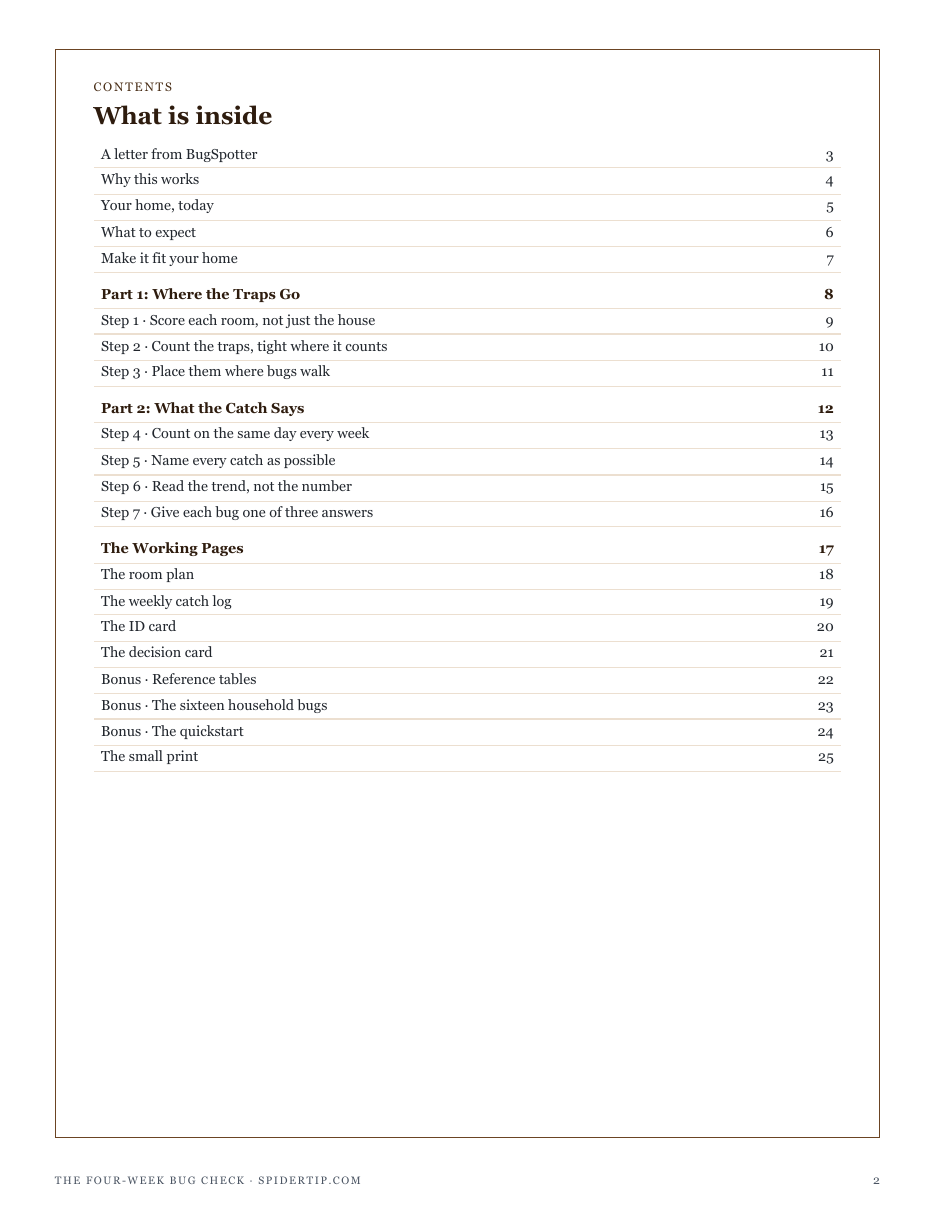
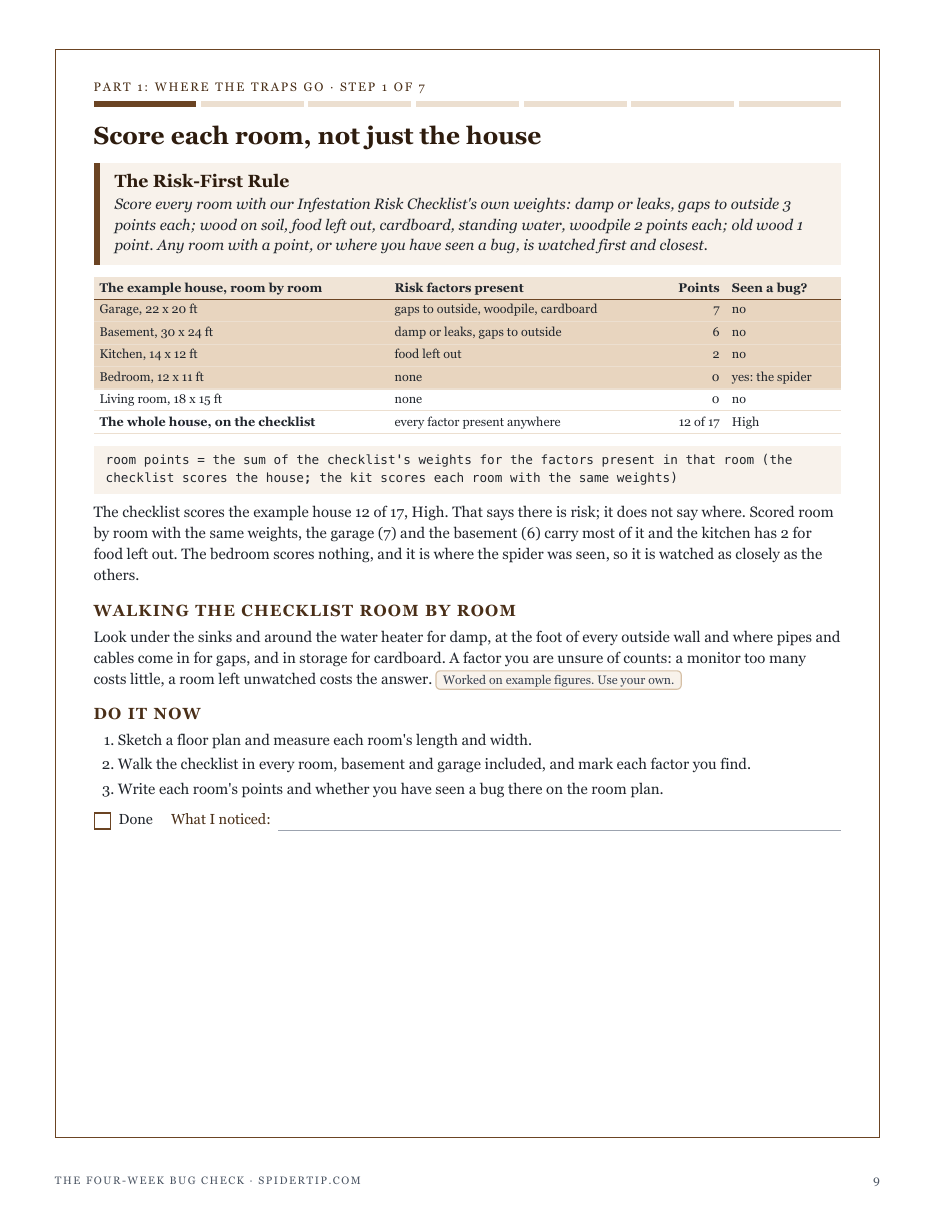
Two full pages from the check, exactly as printed. Click either to read it at full size before you decide.
What is in it
- The Risk-First Rule: every room scored with the Infestation Risk Checklist's own weights, and the rooms with a point or a sighting watched first
- The Tight-Where-It-Counts Rule: monitors 10 ft apart where there is risk, 20 ft elsewhere, never wider
- The Edge Rule: where each monitor goes, the even gap along the walls, and numbering that never moves
- The Same-Day Rule: four weeks of counts by species on the same weekday
- The Possible-Until-Confirmed Rule: legs, antennae, wings and body length to a possible name, and who can confirm it
- The Trend Rule: the last two weeks against the first two, the two busiest traps, and the season
- The Three-Answer Rule: leave it, fix the source, or call a licensed professional, species by species
- Printable working pages: a room plan with a sketch grid, a weekly catch log, an ID card and a decision card
- Reference tables: monitors for common rooms, the checklist's weights, the seasons, and the sixteen household bugs with their first answer, plus a quickstart
- A personalised sheet worked from the numbers you enter in our calculators
- ✓ 25 printable pages
- ✓ 10 sections, worksheets and templates
- ✓ A second PDF worked out from the numbers you enter
- ✓ No account needed, just an email address
- ✓ Instant download; link valid 7 days
Price includes any taxes. Sold by GrabURL, who handle checkout and support. The charge appears on your statement as GrabURL.
The check picks up where the free Trap Spacing Calculator leaves off. It counts sticky monitors for one room, but not which rooms to watch or what four weeks of catches mean. The check scores every room with the Infestation Risk Checklist's own weights, spaces monitors tight where the risk is, counts them on the same day for four weeks, names each catch as possible with the Spider vs Insect ID Key and the Benign vs Nuisance Classifier, reads the trend, and gives each bug one of three answers: leave it, fix the source, or call a licensed professional. A website key sorts a find into a group; it cannot tell a harmless spider from a medically significant one, such as a widow or a recluse, and it is not a basis for treating a bite. Treat every result as possible and confirm with an expert (your county extension office or a licensed pest professional). For a bite, go by the symptoms, not the ID: get medical care for spreading redness, a wound that worsens, severe pain, muscle cramps, or any reaction in a child. In the US, call Poison Control at 1-800-222-1222 with questions. If you use a pesticide, follow its label exactly (the label is the law), keep it away from children and pets, never use an outdoor product indoors, and never set off a fogger near a pilot light or any other ignition source. Heavy or recurring infestations, and anything eating wood, are a job for a licensed pest professional. The room points, the spacing and the trend reading are rules of thumb, and the worked figures are examples.